
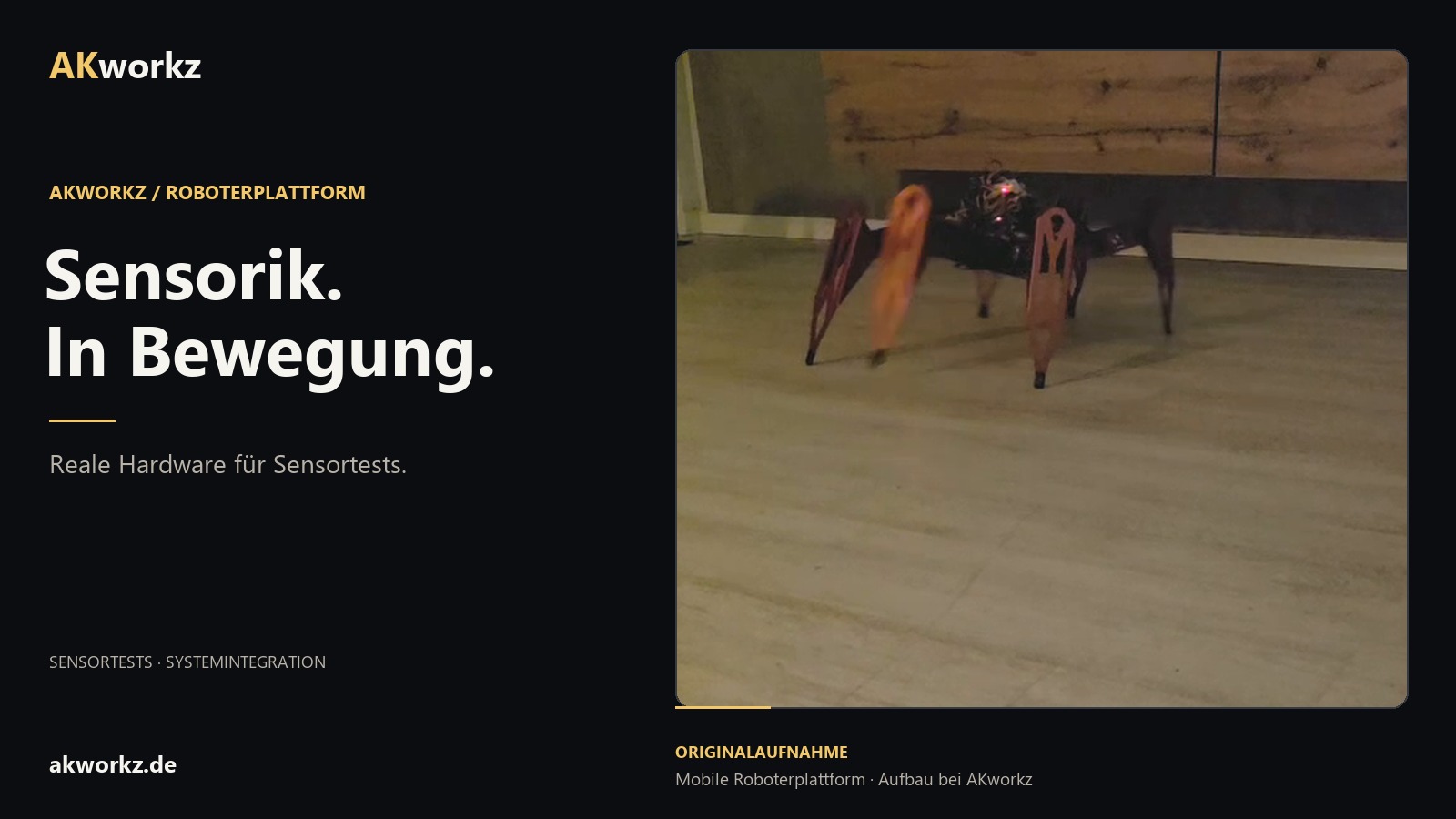
Original VENOM
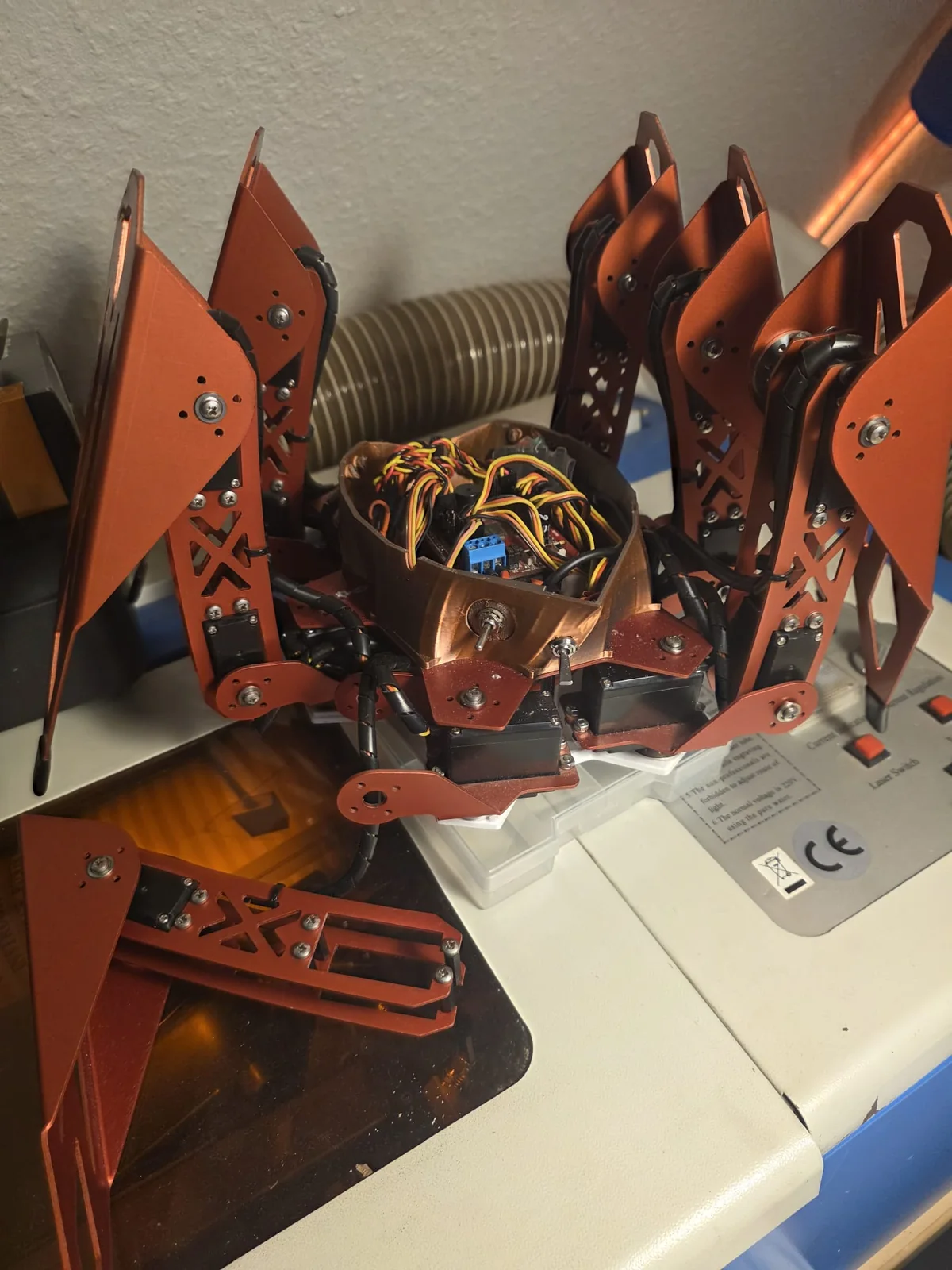
A hexapod from 2012, without CAD data and without spare parts – restored, modernised with our own electronics and connected to a digital twin. With all its successes and all its failures.
Origin: Orion Robotics, 2012
VENOM is the “Venom Hexapod Robot” by Orion Robotics. The platform appeared in 2012 – first under the name “Spike”, from late 2012 as “Venom” – and the assembly guide dates from December 2012. The robot was sold until at least early 2015; after that the manufacturer's website was discontinued.
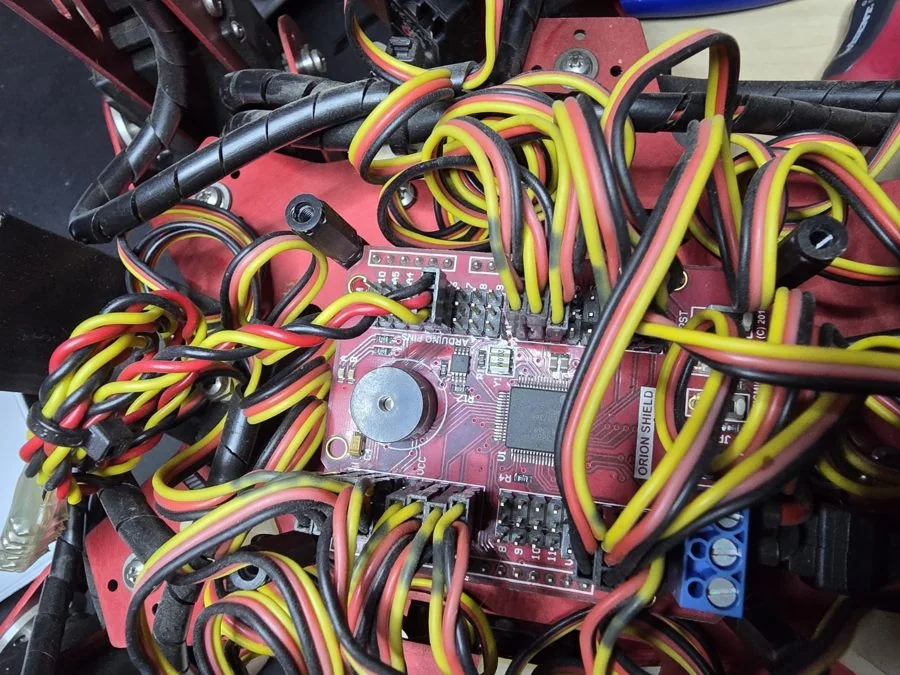
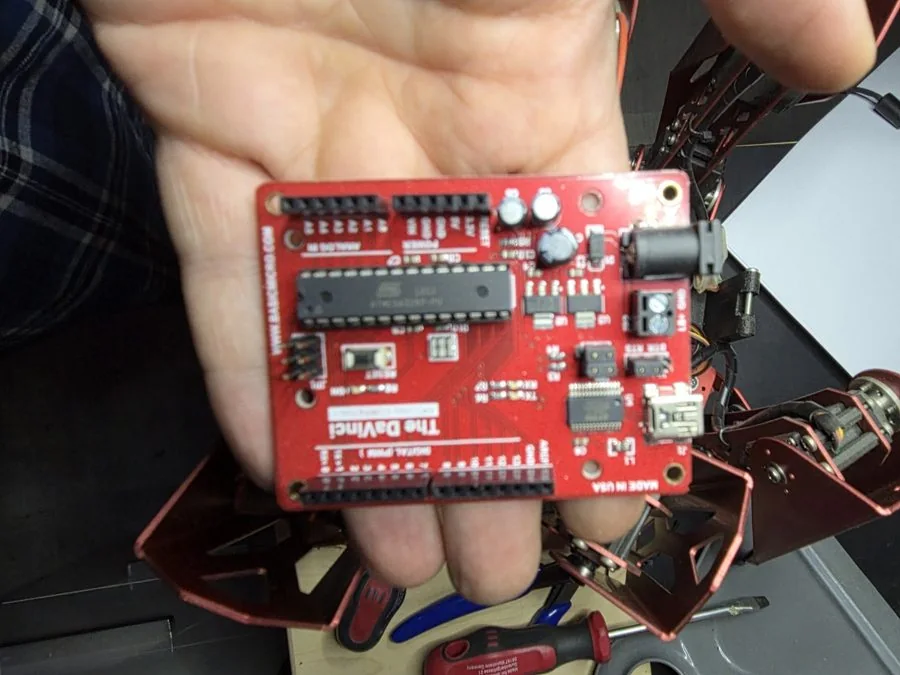
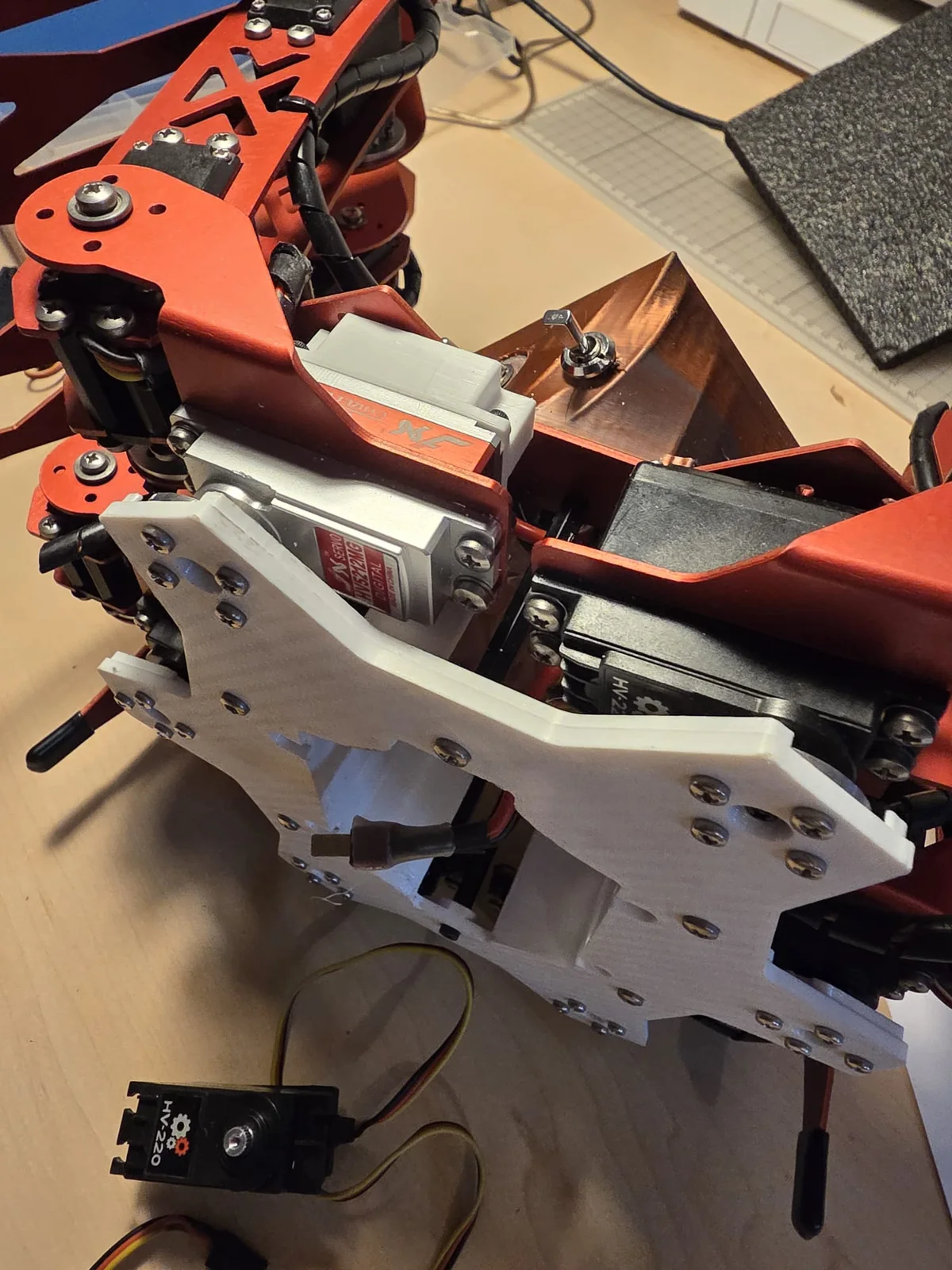
The original: six legs with three joints each, 18 HV220 servos, an Orion servo shield with a Renesas H8 controller that drives the servos and reports angle and load, an Arduino-compatible DaVinci board (ATmega328P) for gait and kinematics, and a PS2 radio remote.
There was no original CAD data. There are no spare parts any more. That is where the real work begins.
Restoration timeline
- October 2026Start: secure the documents, reconstruct the model
Original documents and firmware secured, the CAD model reconstructed in Autodesk Inventor from the assembly guide and real measurements.
- 15 October 2026First printed hood
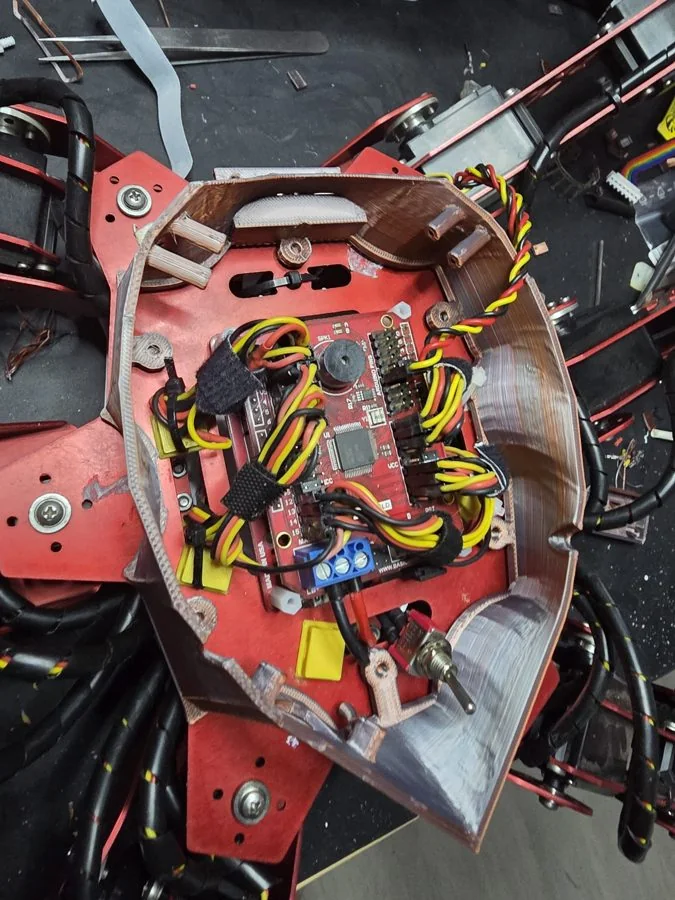
Fitting of the new hood with camera opening – designed around the real range of motion of the legs.
- 21–23 October 2026Interior, eye, first major film
Interior planning between electronics and mechanics, the round display eye runs live, the film “An old robot learns to understand its surroundings” is released.
- 30 October 2026Digital meets real
The real mechanics report joint positions back; the digital twin follows the legs.
- 31 October – 1 November 2026Firmware, radio and first failures
Radio remote on our own firmware, bootloader limit, USB power budget, rear-leg hypothesis disproved – all in the engineering log.
- 7–9 November 2026Servo failures
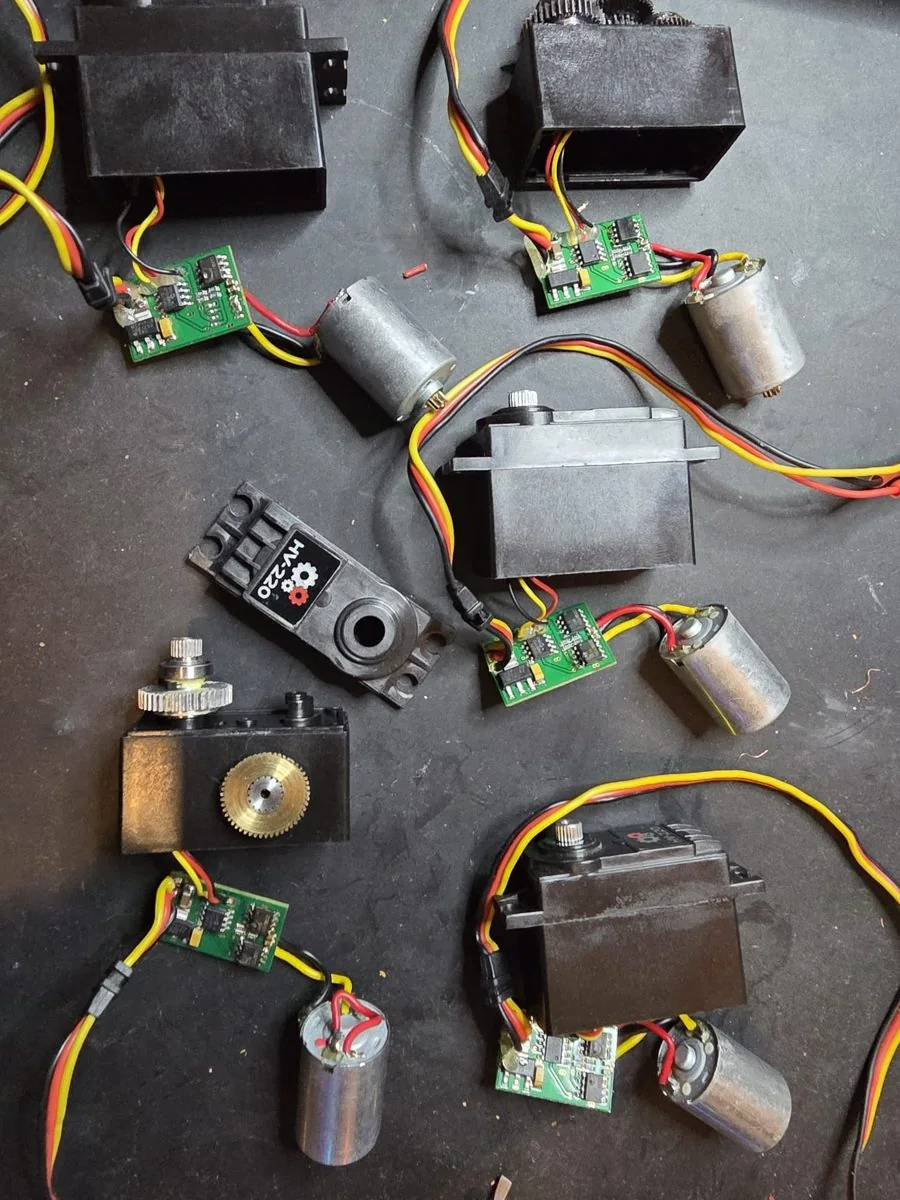
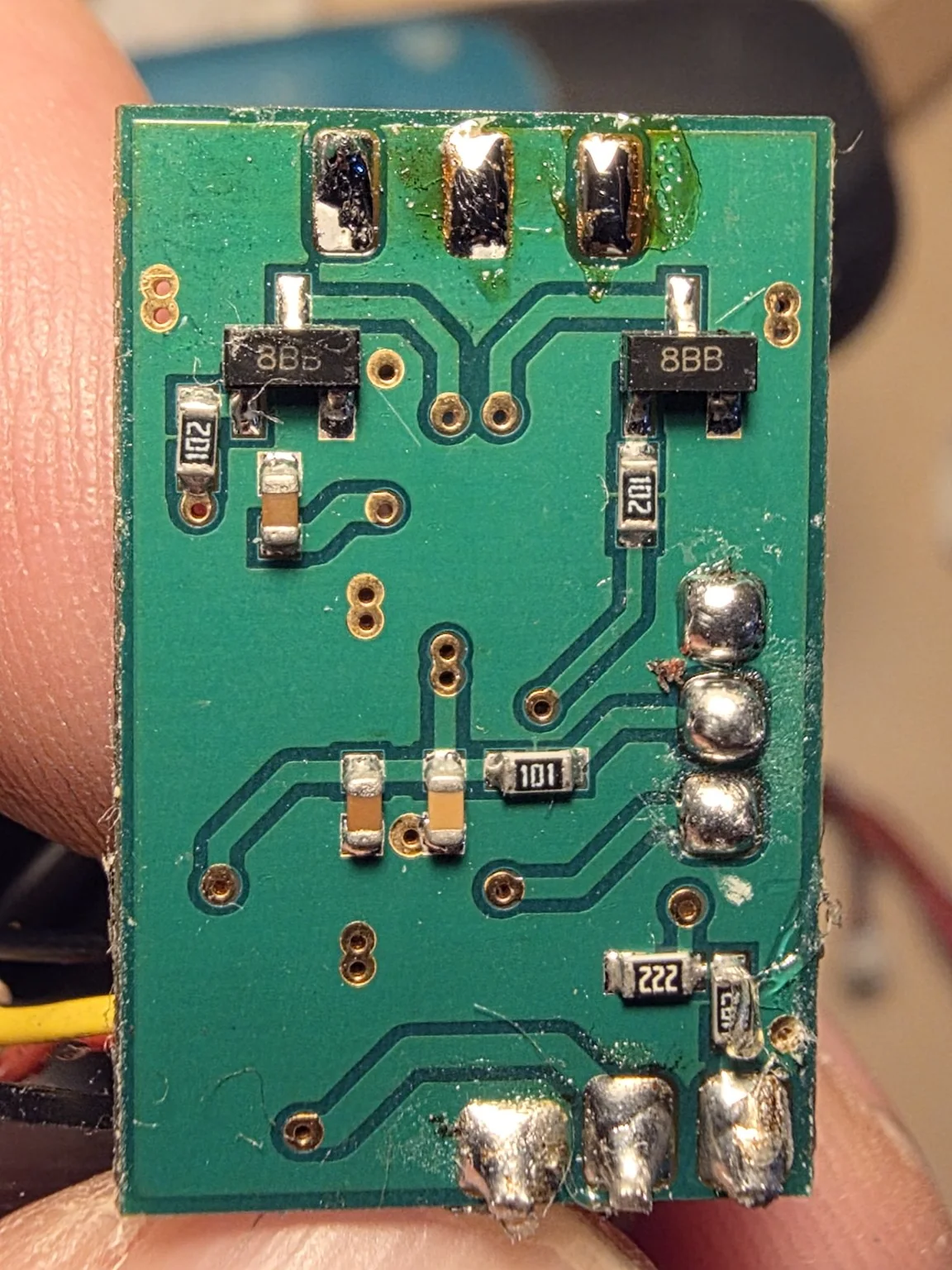
Several HV220 servos fail: damaged gearboxes, burnt H-bridges. The workshop report is published.
- 12 November 2026Arduino UNO Q takes over motion computation
Gait, inverse kinematics, trajectory and balance run on the UNO Q; the Raspberry Pi 5 concentrates on perception. The release for real movements is still pending.
- 17–20 November 2026Formnext 2026 in Frankfurt
VENOM as an exhibit on the booth of KEXCELLED 3D.
- 24 November 2026The next generation is announced
First design drafts of a fundamentally new platform – deliberately without the VENOM name. To the next generation.
Electronics and firmware
Time-critical servo control stays on the proven controllers of the original. On top of them we built a new layer for perception, planning and interaction:
- Raspberry Pi 5 (8 GB): control software on board, perception, state and safety, display eye.
- Arduino UNO Q: since 12 November for gait, inverse kinematics, trajectory and balance; via an STM32 it drives the unchanged Orion servo shield. Hardware steps and motion release are still open.
- DaVinci board (ATmega328P) with our own firmware: radio reception, gait and kinematics as in the original – every flash is verified by a complete read-back.
- ESP32-WROOM with two microphones (MAX4466).
- Sensors: two wide-angle cameras (CM3 Wide, stereo), four VL53L1X ToF distance sensors on an I²C multiplexer, BNO085 IMU.
- Round 2.8-inch display as the eye.
- Separate supplies: 2S LiPo for the drives, 4S Li-ion for the computers.
System architecture
The Raspberry Pi 5 handles perception and planning. Time-critical servo control stays on the proven controllers of the original: the DaVinci board with our own firmware and the Orion servo shield.
Motion
- 18 × HV220 servos, three per leg. Modelled in the twin with position control up to 1.55 Nm; stiffness, friction and inertia are still assumptions there.
- Orion servo shield (Renesas H8): controls the servos and reports angle and load per channel.
- DaVinci (ATmega328P): gait and kinematics as in the original, radio reception, bridge to the Pi. Program memory up to 30,720 bytes, after which the bootloader begins.
Perception and computing
- Raspberry Pi 5 (8 GB) with the control software on board.
- Two wide-angle cameras for a stereo depth image (not yet metrically calibrated).
- Four ToF distance sensors on an I²C multiplexer, BNO085 IMU via SPI.
- ESP32-WROOM with two microphones, round 2.8-inch display as the eye.
Note: the block diagram shows the state of 2 November 2026, before motion computation moved to the Arduino UNO Q.
CAD reconstruction and digital twin
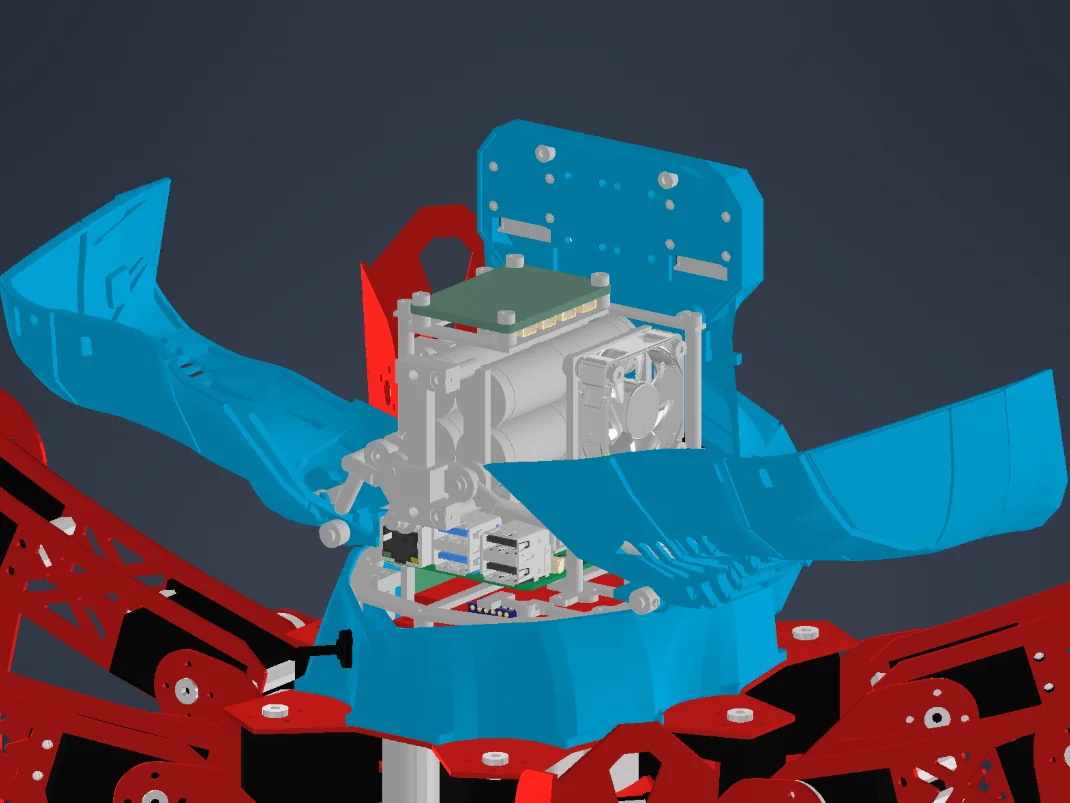
Because there was no original CAD data, we reconstructed VENOM in Autodesk Inventor from the assembly guide and real measurements. Everything builds on this model: the new hood, the interior planning between electronics, mechanics and service – and the digital twin.
The twin runs in MuJoCo, with terrain and stairs. Since 30 October it follows the real legs: move a leg on the table and it moves on the monitor too. Stiffness, friction and inertia are still assumptions in the model – and labelled as such.
More: interior planning · live eye and digital twin · VENOM Studio deep dive (German pages; the deep-dive film has English subtitles)
Kinematics, gait and robot learning
All results in this section come from simulation. None of it has run on the real robot yet.
- Original gaits rebuilt: tripod and ripple pass the complete manoeuvre matrix in the twin.
- End-to-end scenarios: 17 of 20 passed; quadruped gait and stairs are fixed on a development branch.
- Robot learning: a learned gait correction lowers the peak joint load on flat ground by 4–5 %. In rough terrain neither CEM nor PPO finds a solution below the 1 Nm limit – and we did not relax the limit.
- Limp mode on five legs: investigated in simulation; the real robot is not ready for it.
The details with all figures are in the engineering log.
Development status at a glance
Every statement about VENOM belongs in exactly one of these six groups. What is only simulated does not appear under “tested on hardware”.
- Radio remote on our own board firmware: START switches on the servos and moves to the home position, standing up and driving via the remote, signal tones as in the original.
- Joint feedback: a leg moved by hand appears in the digital twin.
- Data link Pi 5 ↔ servo board with the remote active, without lost requests.
- Raspberry Pi 5 with control software, cameras and round display eye in operation.
- Raw servo load values on all 18 channels.
- New gait via the robot logic for studio, Bluetooth controller and voice commands – not yet driven on the robot.
- Calibration via the remote as in the original: menu reachable, real calibration not yet performed.
- Joint tool in the studio for moving individual joints.
- Energy analysis and drive identification – so far only with simulated or synthetic data.
- Digital twin in MuJoCo with the original gait and a second gait controller.
- 17 of 20 end-to-end scenarios passed; fixes for quadruped gait and stairs on a development branch.
- Individual test cases: narrow passage, lowering, distance to people, self-righting.
- Learned gait correction: 4–5 % less joint load on flat ground.
- Troubleshooting the right rear thigh servo.
- Mounting reference of the IMU (calibration poses); until then safety functions run with fallback assumptions.
- Measurement series and calibration of the ToF sensors.
- Navigation between objects without contact (simulation).
- Load balancing while standing for uneven terrain.
- First real walking test with the new gait.
- Calibration of the legs via the remote on the robot.
- Current sensors for real energy measurement.
- Longer autonomous patrols only after a passed overall test.
- Torque cut-off as the cause of the hanging rear leg – disproved.
- Firmware update reached into the bootloader; board only recoverable via ISP.
- Speech recognition via the robot's own microphones – signal-to-noise ratio too low.
- Learned policy in uneven terrain – no solution below 1 Nm.
- Complete autonomous patrol in simulation – not yet passed.
This overview shows the state of 2 November 2026. What happened afterwards is in the timeline and in the engineering log.
The problems with the HV220 servos
The 18 HV220 servos are the heart – and the weak point – of the original. Orion specified them with “220 oz·in”, “0.12 s/60°” and “7.4 V LiPo safe”; a complete data sheet can no longer be found, and we have not measured these values ourselves.
From early November several servos failed: damaged gearboxes, stalling motors and burnt H-bridges, some with burst component packages. Some servos only turn in one direction.
- We found no replacement gears or used parts.
- Third-party servos provide no force or position feedback on the Orion shield.
- Our decision: modernisation instead of 1:1 replacement. We examine and repair defective servos under the microscope; for the rear left hip a replacement servo without feedback is planned, and the control treats this joint as “commanded, not measured”.
- In parallel, a design for new servo electronics is being drafted. Nothing of it has been built yet.
This experience is the main reason for the next generation with smart servos. Read the full workshop report: When servos fail and electronics blow up.
Formnext 2026
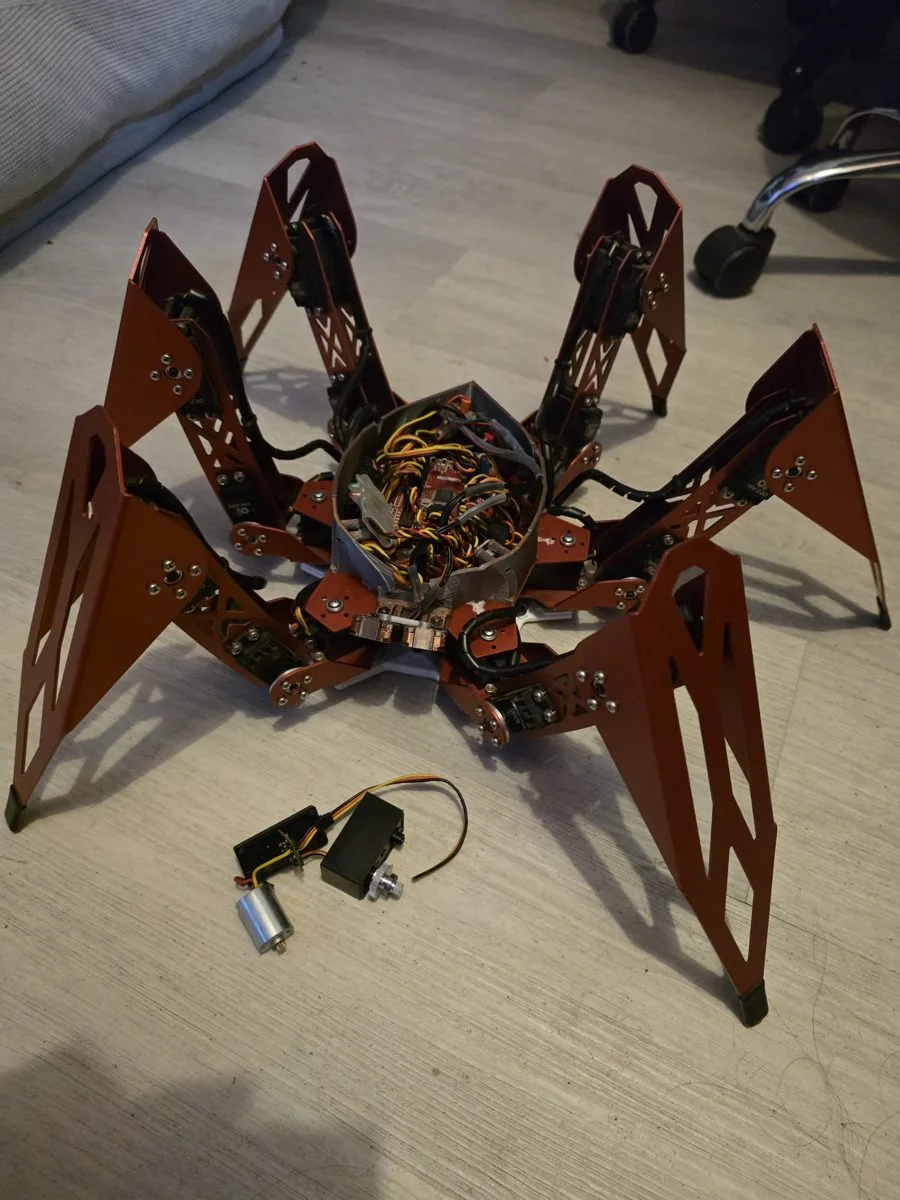
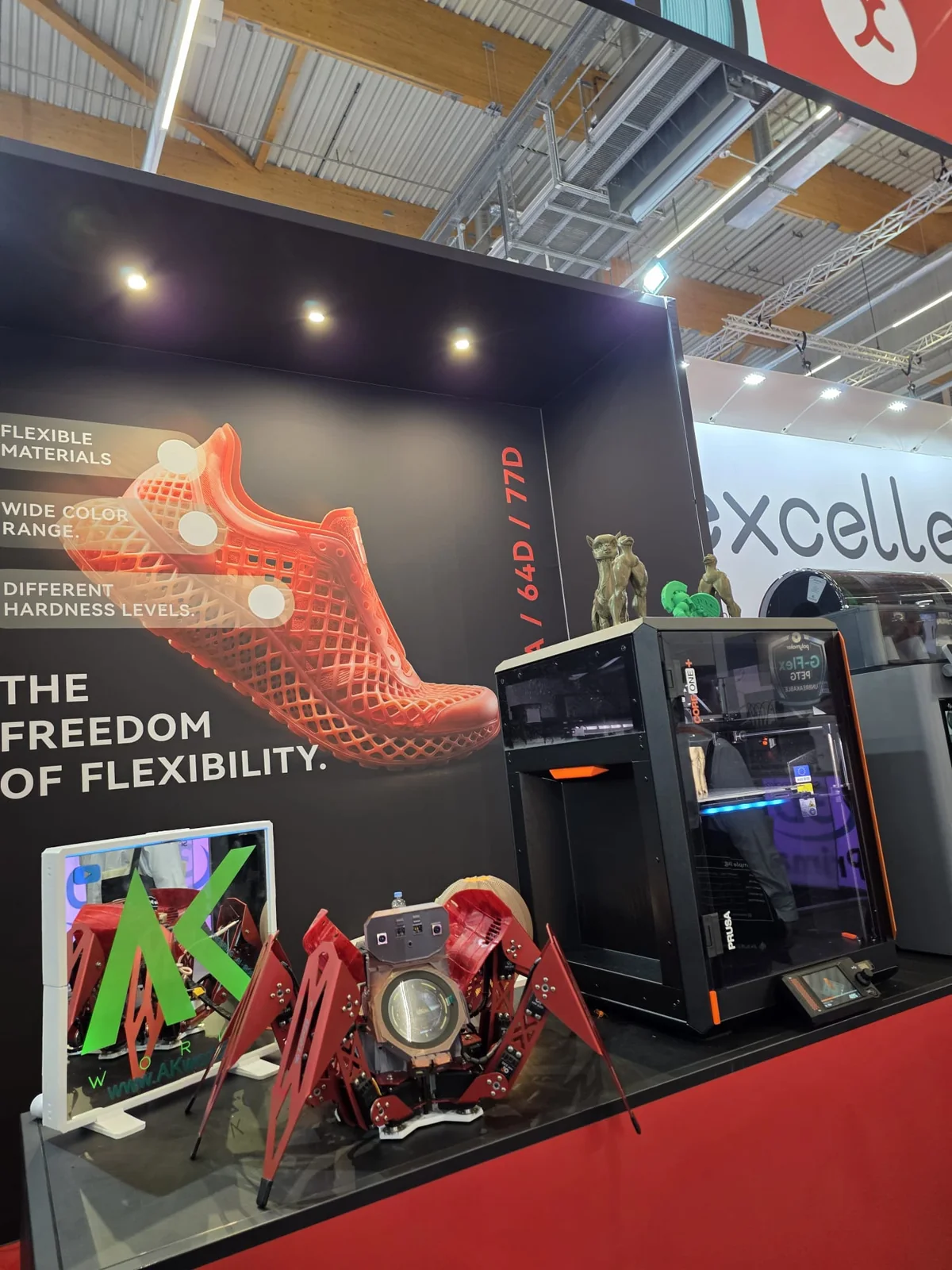
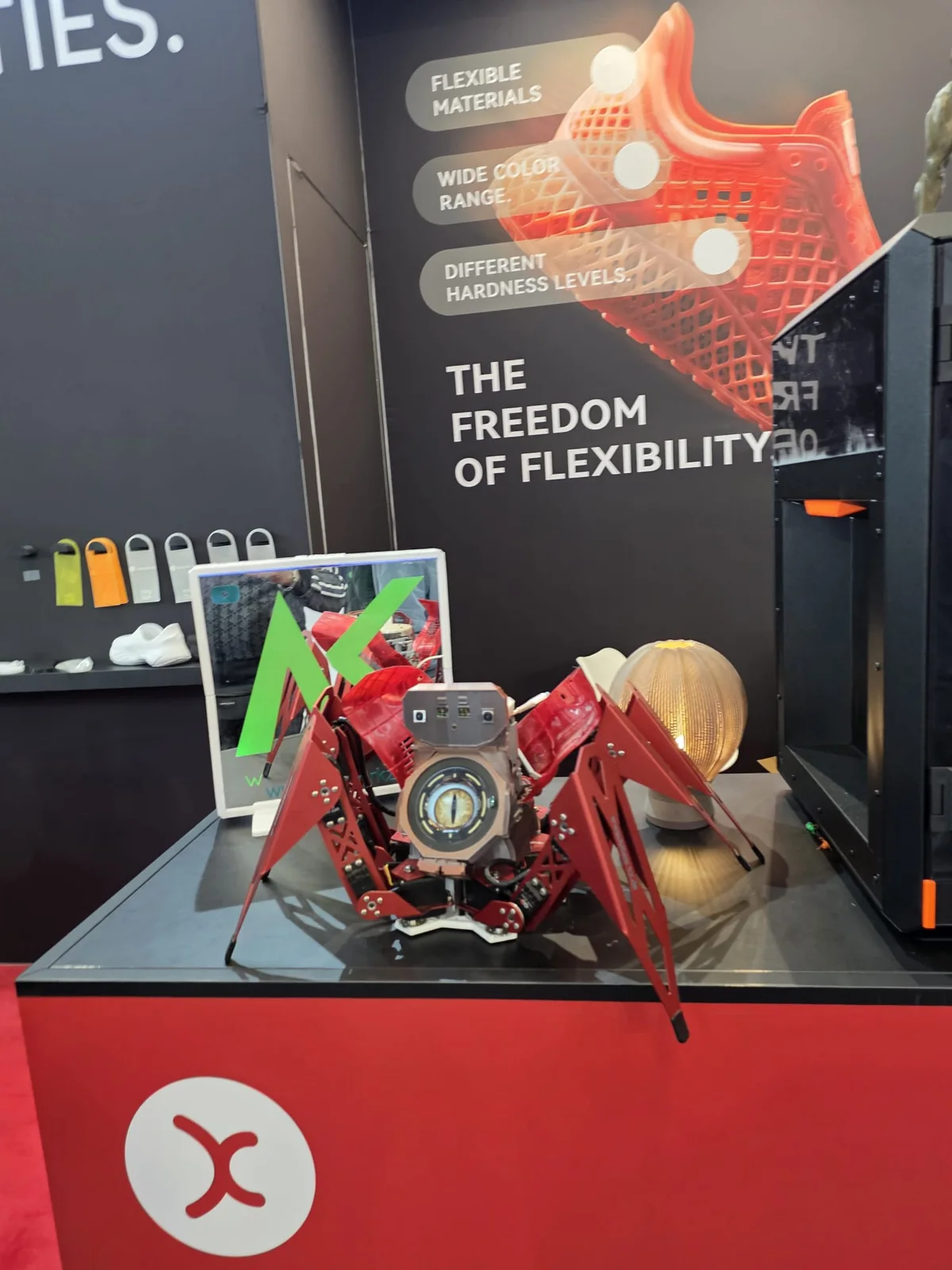
From 17 to 20 November 2026, VENOM was at Formnext in Frankfurt, the international trade fair for additive manufacturing – as a guest on the booth of KEXCELLED 3D. We showed the restored robot as an exhibit, not walking: battery and computer link were disconnected for the fair, and the round display eye ran in a dedicated show mode. In addition there was a purpose-built AKworkz light sign with a 3D-printed frame.
Thank you to KEXCELLED 3D for the invitation and the hospitality. Photos and films: Media, exhibitions & events.
Next steps (as of 2 November 2026)
On the robot
- Clarify the cause at the right rear leg (connector swap).
- Calibrate the legs via the remote.
- Determine the mounting reference of the IMU.
- First walking test with the new gait.
- ToF measurement series, microphone hardware.
In software and simulation
- Navigation between objects without contact.
- Fix self-collision during foot placement.
- Load balancing while standing for uneven terrain.
- Calibrate stereo depth metrically.
In the documentation
- In-depth articles on electronics and power supply – after physical acceptance.
- Twin versus hardware: publish measurement series once available.
- English version (done with this portal).