
VENOM Engineering Log
This is the English version of the German engineering log. Measurements, figures and verification status are identical in both languages.
VENOM: When servos fail and electronics blow up – a look into our robotics workshop
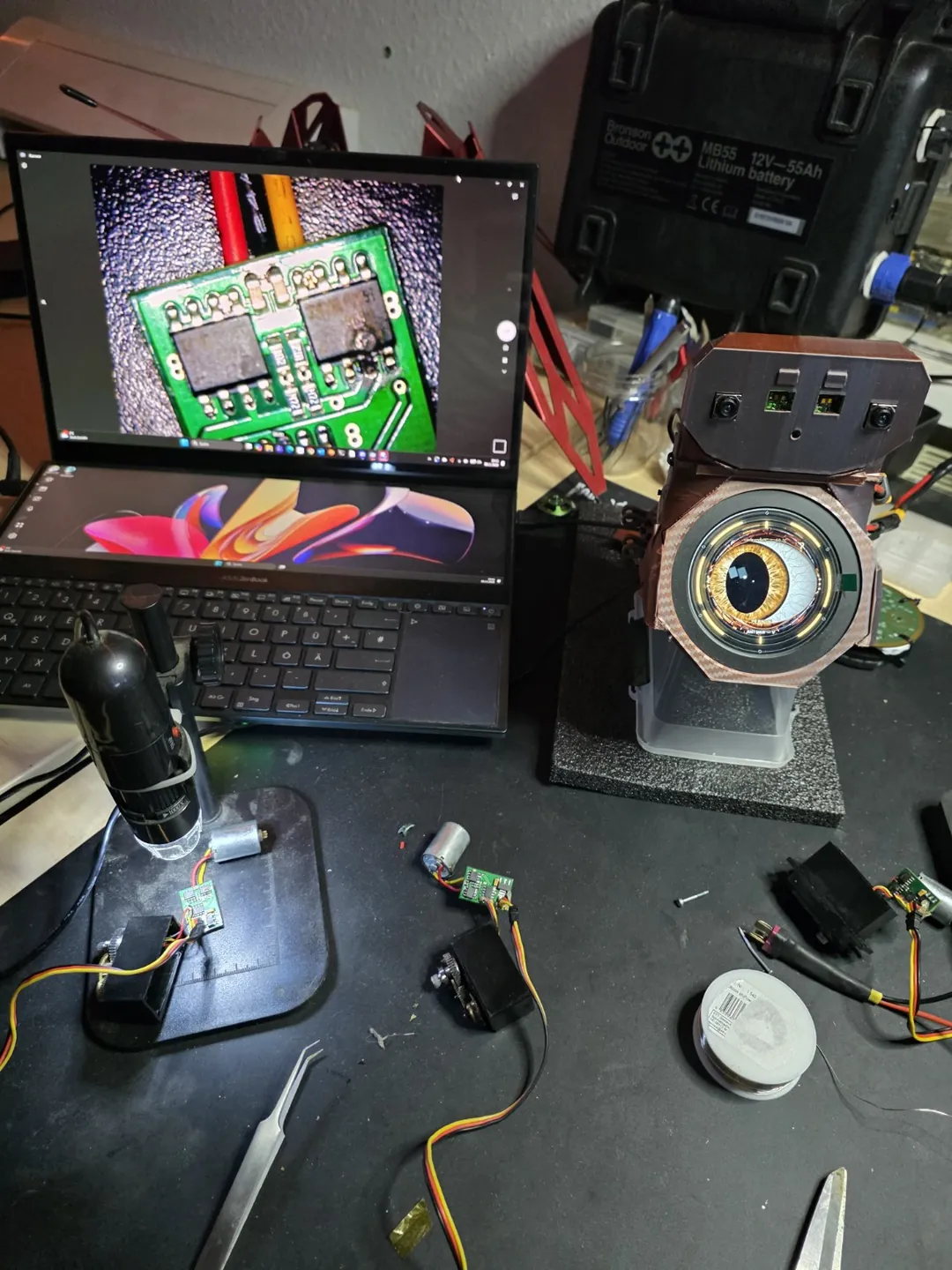
18 joints, damaged gearboxes, destroyed power electronics and a great deal of troubleshooting: why VENOM is currently on the operating table – and why these setbacks are an important part of its further development.
Rear leg won't lift: the IK torque-stop hypothesis disproved
Goal: Find out why the right rear femur lags behind when standing up while the other five legs lift the body.
Starting point: When standing up, the affected servo reports a very high load and stays about 16° behind its target position. The servo controller sends it practically the same pulse as the same joint on the right front leg, which follows cleanly.
Approach:
- Check the feedback: Leg moved by hand – the digital twin follows. The angle feedback of this joint is fine; the seemingly “frozen” position was the real position of the leg.
- Cross-check the firmware: An older firmware version shows the same behaviour.
- Compare with the original: At start-up, the original firmware switches off the automatic torque cut-off of the femurs in the servo controller; our firmware did not. Hypothesis: the torque cut-off holds back the most heavily loaded leg. We built a version with exactly this start-up step, flashed it and tested it on the robot.
Result: Even with the torque cut-off disabled, the leg does not come up. The hypothesis is disproved. We therefore returned to the previous state in which the torque cut-off stays active – load monitoring is explicitly meant to be on. The raw load values continued to arrive on all 18 channels in both versions.
Insight: Sensors, firmware and setpoints are practically ruled out. What remains is the drive side (servo, gearbox, supply, connector, cable) and the output of the servo controller.
Next step: Swap connectors with the front right femur. If the fault moves with the connector, servo or cable are to blame; if it stays at the rear, it is the controller output.
Simulation: 17 of 20 end-to-end scenarios – and what is behind the three red ones
Starting point: The complete run of all 20 end-to-end scenarios in the twin passed 17. Red were the autonomous stair target, navigation between objects (5 of 6 goals) and walking on four legs (no propulsion). On the unchanged baseline the same three are red – so these were existing weaknesses, not new bugs.
What we found and changed (development branch, not yet merged into the main line):
- Quadruped: In the four-leg stance, the raised front legs stood in the measuring cones of the ToF sensors. With a changed posture the test is green.
- Stairs: Overhead obstacles now only count from sufficiently precise map hits – that alone turns the goal test green. In addition, the body turns at a cold start when the first course is oblique and the ground ahead has not yet been observed, and the touchdown search avoids points that the front ToF sensors cannot see.
- Navigation: Now 6 of 6 goals, but two contacts with a 20 mm high bar. Causes: the 50 mm map cell averages floor, bar edge and top to 5–13 mm – below the 15 mm threshold for “raised”. And a ramp exception connects such a low bar to the floor.
Further real causes that became visible: One foot placement leads to a self-collision (“knee in the body”), and the pose estimation stores a wall seen at an angle as 94.8° instead of 90° and then corrects in the wrong direction. Both are being fixed.
Rule: No threshold and no test condition is relaxed to make a test green. A change is only adopted when no previously green test turns red.
Robot learning in the digital twin: small gains, honest limits
Goal: Check whether a learned correction (residual) on top of the existing gait lowers the load on the servos without violating hard safety limits.
Setup (simulation only): MuJoCo twin built from our reconstructed CAD model. The policy may only change step height, step duration and later speed (0.4–1.0) and body height (±15 mm) within the limits of the existing gait. Hard limits: joint torque below 1.0 Nm, tilt below 5°, servo saturation below 0.05 s. Ground friction is varied in training.
Result on flat ground (friction 0.6 and 1.4, not seen in training, two seeds each):
- Forward: peak joint torque −4.8 % and −3.6 %
- Turning: −2.7 % and −2.6 %
- Sideways: −1.5 % and +1.8 % – i.e. worse once
What was mainly learned is a 10–12 % longer step duration.
Result in rough terrain: On uneven terrain even the existing gait exceeds the 1 Nm limit (1.31–1.49 Nm); the policy also stays above it at 1.05–1.41 Nm. Neither CEM nor PPO finds an admissible solution. We did not relax the limit.
New finding (1 Nov): Over the complete runtime path with its own environment map, the ramp stays within all limits (0.86 Nm, 1.3°). The earlier negative ramp result came from the simplified test setup. Uneven terrain remains above the limit at 1.40 Nm.
Insight: Step timing and step height are not the lever. What is needed is force-based load balancing while standing and better near-field perception before the first step. We are working on this as a separate topic. None of this runs on the hardware yet.
Radio remote control as in the original – on our own board firmware
Goal: The original PS2 radio remote should work on our new board firmware exactly as it did with the original firmware. At the same time, the Raspberry Pi 5 should continuously read joint angles and load values from the servo board.
Starting point: With the new firmware not a single radio packet was valid, and as soon as the remote was active, requests from the Pi were lost.
Causes found (selection):
- Compiler, not code: The newer compiler (avr-gcc 7.3) no longer inlines a delay loop of the software serial interface. As a result the receiver sampled every bit too late and every checksum failed. We re-derived the timing table by counting clock cycles in the generated machine code.
- Servo controller only searched for at start-up: If it did not answer at that moment, it stayed invisible until the next reset. Now the firmware searches again every 500 ms.
- “S-motion” when standing up: The hips swung back and forth because the complete kinematics configuration was rewritten to the servo controller before every stand-up. The original uses the values stored there. Without this write sequence VENOM stands up “cleanly, as before” again.
- Lost Pi requests: The radio interrupt has priority over the UART interrupt. During a 24-byte radio packet the receive buffer of only two bytes overflowed, and 4–5 % of the requests were lost. Now the radio interrupt itself collects the waiting UART bytes at the end of each radio byte: 0 losses and 6.2 instead of 4.2 queries per second.
Result on the robot: START switches the servos on and moves to the home position, standing up and driving via the remote work, the signal tones match the original. The calibration menu is reachable; we have not yet performed a real calibration.
Insight: Same source code does not mean same timing. For time-critical protocols on 8-bit controllers, the generated machine code decides – you have to read it, not just the C++ source.
Firmware too large: how an update hit the bootloader area
Starting point: A 31,856-byte firmware update for the servo board (ATmega328P) was written, and the flashing tool reported the data as verified. Afterwards the board no longer answered over USB and the leg feedback failed.
Cause: With the configured fuse settings, the bootloader starts at 30,720 bytes (address 0x7800). The program was larger and reached into this area.
Solution: The board sits at the very bottom of the robot; access means partial disassembly. We rescued it with an ISP programmer (direct programming connector) and read out the fuse values in the process.
What changed in the workflow:
- Every build checks the 30,720-byte limit and keeps a reserve.
- Only the application area is flashed, as a complete, padded image.
- Before and after every flash we read back the complete memory and compare the checksum with the expected state.
Insight: When flashing, “verified” only means that the bytes written are correct – not that the program fits into the available space.
Unstable Wi-Fi dongle: the USB power budget of the Raspberry Pi 5
Starting point: The robot's Wi-Fi connection via a USB dongle kept dropping.
Cause: If the Raspberry Pi 5 does not detect a 5 A supply (here the firmware reported 3 A and no USB-PD data), it limits the current for all USB devices together to 600 mA. 760 mA were registered: Wi-Fi dongle 450 mA, round display 120 mA and two USB-serial adapters with 100 and 90 mA.
Solution: usb_max_current_enable=1 in the boot configuration raises the limit to 1.6 A. After the reboot the setting was active, there was no over-current message, and the dongle starts reliably.
What remains open: The radio quality on the Wi-Fi channel in use is still moderate (around 8 % packet loss). That is a separate topic.
Note for builders: Only set this option if the power supply can actually deliver the higher current.
Digital meets real: the twin follows the real legs
What happened: For weeks VENOM lived mainly in the digital twin. Now the real mechanics report joint positions, servo load and motion back. Move a leg on the table and it moves in the twin on the monitor as well.
Why it matters: A twin is only as good as its match with the real machine. With the feedback we can align model and body joint by joint.
Context: The robot stood supported on the table. Walking tests combining twin and hardware are still pending.
Microphones: signal-to-noise ratio measured – software cannot save this
Goal: VENOM should recognise voice commands such as “stop” through its own two microphones (MAX4466 on the ESP32).
Measurement on the robot: Five pairs of silence and played-back speech output.
- In the sum signal of both microphones, speech cannot be distinguished from the normal fluctuation at rest (±1.1 dB). The signal-to-noise ratio there is at most −5 dB.
- In the difference signal (left minus right) it is measurable, but only at +2.0 to +3.4 dB. 98 % of the noise is identical on both channels (common mode) – an indication of supply or ground rather than airborne sound.
- Wi-Fi on or off makes no difference.
Cross-check in simulation: Calibrated to these measurements, no software variant recognises the commands. 15 to 20 dB more signal at the source would be needed. An earlier estimate of our own of “+8 to +10 dB” was wrong and has been corrected.
Insight: Measure first, then filter. A filter cannot conjure up a signal that has disappeared in the noise.
Next step: Hardware diagnosis in three steps: cover the microphone capsules (airborne sound or electrical coupling?), power the amplifiers from batteries as a test, tie the ADC input to a fixed reference voltage.
← Back to the VENOM project portal · Development status and system architecture of the original VENOM