
VENOM: When servos fail and electronics blow up – a look into our robotics workshop
9 November 2026 | AKworkz Robotics | Development & Research
English translation of the original German article by Atilla Karsli.
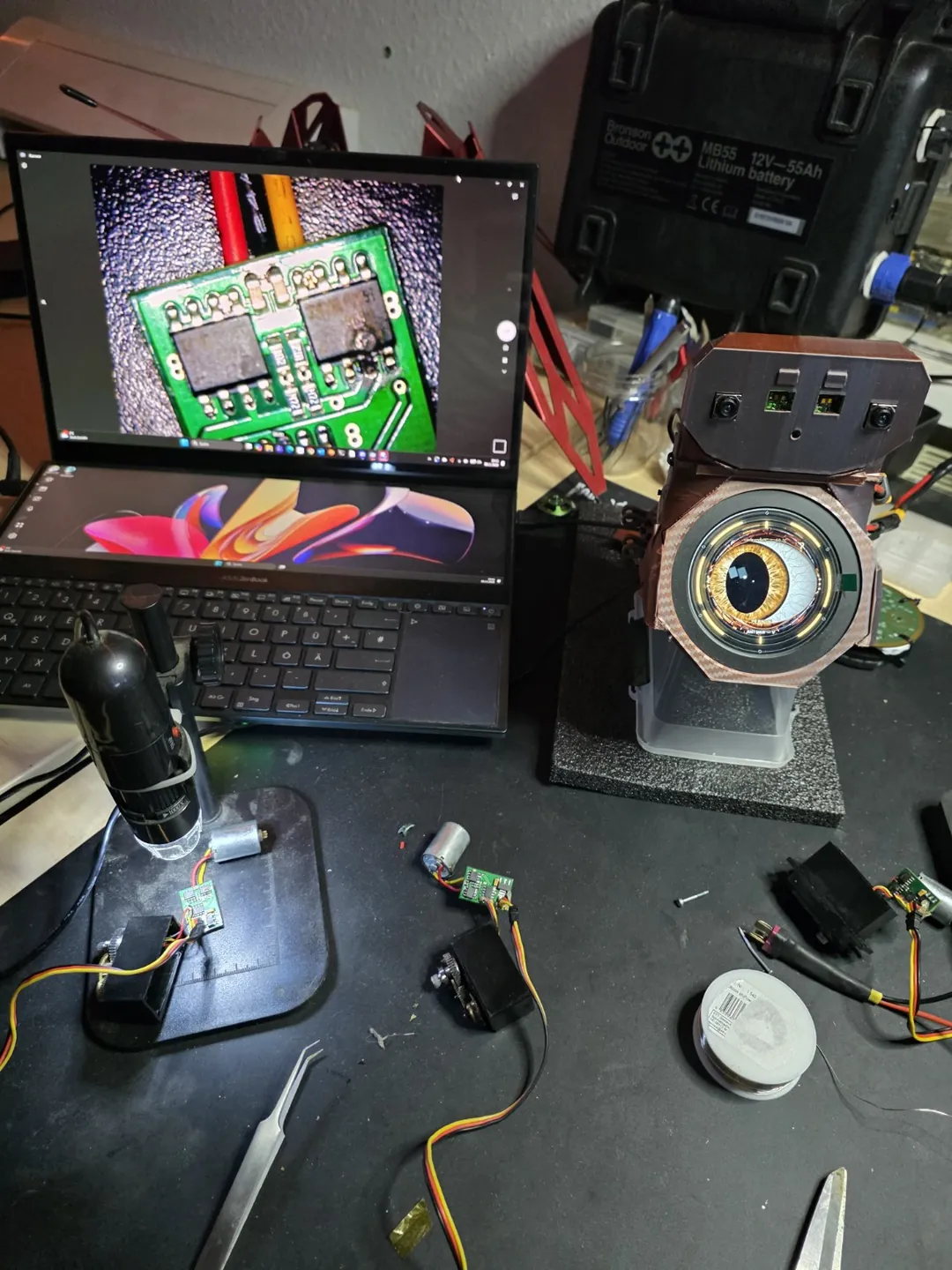
A robot is not built at the computer alone
Anyone following modern robotics often sees impressive demonstrations: robots that walk, overcome obstacles and interact with their surroundings seemingly without effort.
What you see less often are the hours in between.
The nights at the microscope. The burnt-out components. The troubleshooting on tiny circuit boards. And the question of why a drive still worked yesterday and today suddenly does not make a sound.
That is exactly where we are with VENOM right now, our six-legged research robot at AKworkz.
VENOM is being comprehensively modernised. New sensors, more powerful computing units, AI-assisted control and a digital twin are meant to turn it into an intelligent, autonomous research platform in the long run.
But before we can take the next big steps, its legs have to work reliably again.
And that is proving to be a real challenge.
When the H-bridge becomes the weak point
VENOM has 18 driven joints. Each of them needs a servo that not only has to be positioned precisely but must also absorb considerable mechanical loads.
Several of our existing servos have developed defects in the meantime.
And the damage is by no means limited to the mechanics.
Besides damaged gearboxes and stalling motors, we have also found failures on the control boards. Components in the area of the H-bridges are particularly affected – the power electronics that control motor current and direction of rotation.
Some components are visibly burnt out. In some cases the package actually burst open.
Other servos show a particularly interesting fault pattern: one direction of rotation still works while the other has failed completely.
Such symptoms can point to damaged power semiconductors or to their driver circuitry. We are currently investigating the exact cause.
Our goal is therefore not just the repair, but understanding the failure mechanisms.
Because a robot that is later meant to walk on its own and react to changing loads needs one thing above all: reliable drives.
Microscope, hot air and surgical precision
Our current workshop photo shows part of this work.
Under the digital microscope we examine the control boards of the defective servos. On the screen you can see two power semiconductors in eight-pin SMD packages.
With a hot-air rework station, flux and precision tweezers these components can be desoldered selectively.
Among other things, we are currently trying to transfer intact components from damaged boards to other control boards.
That sounds simple at first: remove the component, prepare the pads, fit the replacement and solder it again.
In practice it takes a fair amount of finesse.
The boards are small, the components sit close together, and too much heat can cause additional damage.
On top of that, before a permanent repair we also have to check the motors and the rest of the power electronics. After all, a possibly blocked motor should not immediately destroy the next driver.
The point is to recover working drives from the existing components and at the same time identify the actual weak point.
Why we don't simply buy 18 new servos
VENOM is a privately funded development and research project.
We develop the mechanics, electronics, software and AI integration largely ourselves and continuously invest in new components, tools and test setups.
Replacing all 18 drives would be correspondingly expensive.
But money is not the only reason for our repair attempts.
The existing servos provide valuable insights into mechanical loads, motor drivers, thermal limits and possible weak points in the overall system.
These experiences flow directly into the planning of the next drive generation.
In parallel, we are in contact with various manufacturers and potential development partners to evaluate suitable alternatives.
This is not only about more torque. We are also looking at feedback systems, current draw, controllability, mechanical integration and long-term spare-parts availability.
Meanwhile, VENOM is getting new senses
While the servo repairs are under way, the rest of the robot keeps developing.
Our planned architecture combines, among other things:
- Raspberry Pi as the central computing platform for higher-level software and AI functions
- Microcontrollers for time-critical control and sensor tasks
- IMU sensors to capture orientation and motion
- Distance sensors and cameras to perceive the environment
- Force sensors on the feet to detect ground contact and loads
- Audio hardware with microphones and speakers for direct interaction
In parallel we are working on a simulation environment and a digital twin so that motions, control strategies and new functions can first be studied virtually.
In the long run, VENOM should not simply execute pre-programmed motion sequences but perceive its environment and adapt its movements intelligently.
That is the path from classic robot control towards Physical AI.
A robot watching its own repair
One small peculiarity of our current workshop setup is hard to miss in the photo.
Right next to the microscope stands VENOM's new head with its distinctive eye.
While we work on its defective drives, it is, in a way, watching us.
Of course this is not yet a complete autonomous perception of its own repair. But it shows nicely the direction in which we are developing.
A robot with cameras, microphones, sensor fusion and an AI-assisted software architecture should in future be able to do much more than just react to control commands.
It should interpret its surroundings, interact with people and monitor its own states.
And perhaps one day even recognise when one of its joints draws unusually high current or no longer moves as expected.
Repair, understand, improve
In robotics, progress cannot always be seen in spectacular movements.
Sometimes progress means finally being able to reproduce a fault.
Or successfully replacing a destroyed power semiconductor.
Or finding out why a joint fails under load.
VENOM is in exactly this phase right now.
We are repairing damaged drives, examining their electronics, evaluating new components and, in parallel, developing the next generation of its control architecture.
The next steps are the electrical testing of the repaired boards, controlled motor and load tests and the step-by-step recommissioning of the joints.
Our aim remains unchanged: VENOM should not just walk again. Afterwards it should be more intelligent, more reliable and technically easier to understand than before.
Because real research does not mean that everything always works.
It means continuing to develop even when something breaks.
About the VENOM project
VENOM is a privately developed six-legged research robot by AKworkz. It focuses on robotics, embedded systems, sensor fusion, artificial intelligence, digital twins and research into intelligent motion control.
The project is documented step by step and offers insights into real development processes – including technical challenges, failed attempts and new findings.
AKworkz – Engineering, Robotics & Physical AI