
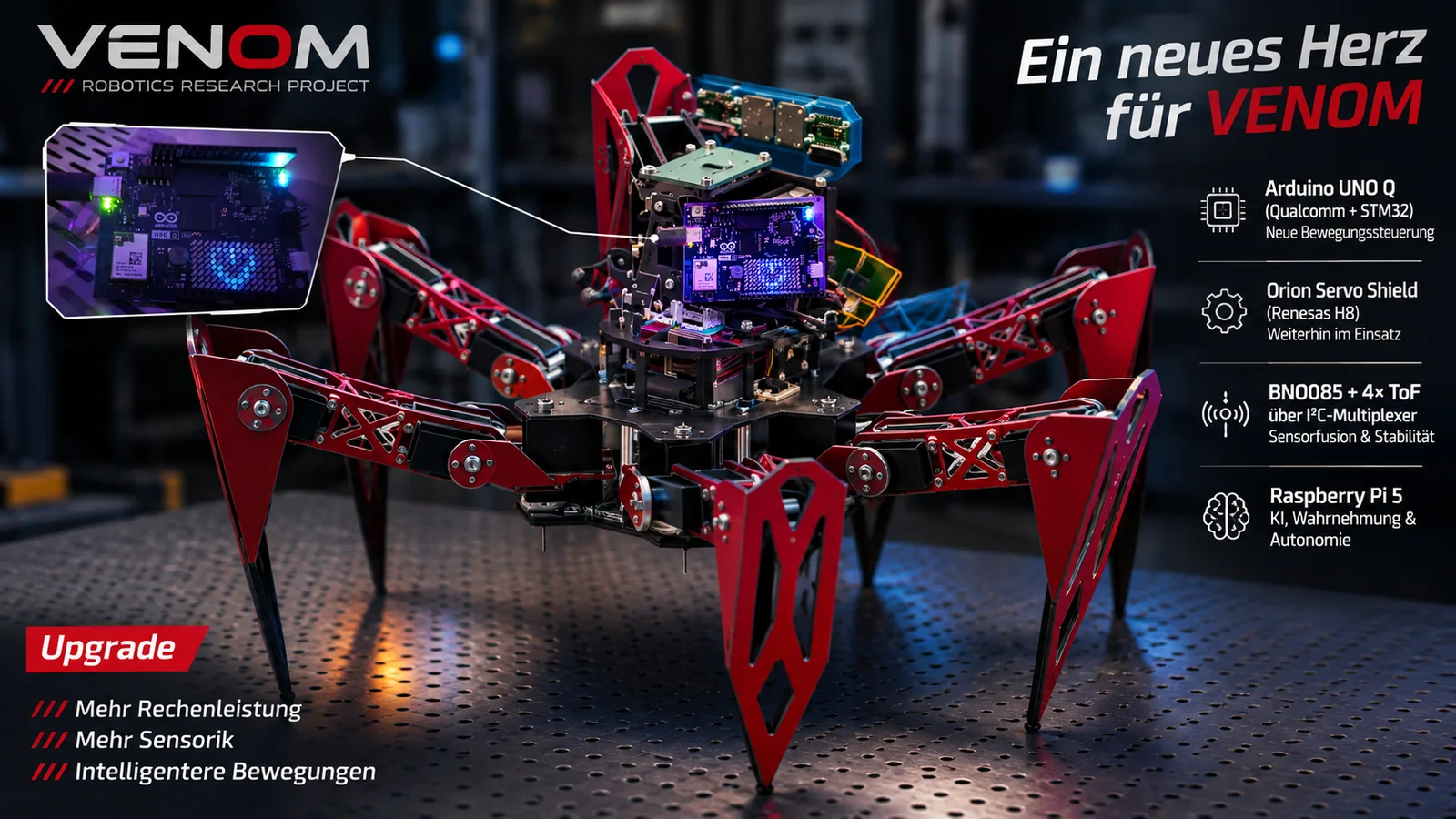
VENOM gets a new heart: Arduino UNO Q takes over motion computation
12 November 2026 | AKworkz Robotics | Embedded & motion control
Why a new controller?
The original DaVinci board (ATmega328P) moved VENOM for many years. For what we have in mind – gaits that adapt to the ground, sensor fusion, reactions to ground contact and unexpected load – 32 KB of program memory and 8 bits are no longer enough. How tight it was is shown by the entry “Firmware too large” in the engineering log.
The Arduino UNO Q combines two worlds on one board:
- Qualcomm Dragonwing with 4 × 2 GHz running Linux – for motion planning, inverse kinematics, gaits and sensor fusion.
- STM32U585 at 160 MHz – for time-critical control, sensor data and communication with the servo electronics.
The new division of labour
Raspberry Pi 5 → Arduino UNO Q (Linux) → STM32 → Orion servo shield (Renesas H8) → 18 servos.
- Raspberry Pi 5 remains the higher-level brain: perception, cameras, speech, autonomous decisions and the digital twin. It no longer computes motion.
- Arduino UNO Q computes gait, inverse kinematics, trajectory and balance.
- The STM32 on the UNO Q talks to the unchanged Orion servo shield, which controls the servos and reports angle and load.
In short: the AI decides where VENOM wants to go. The UNO Q takes care of how it gets there in a controlled way. That includes position and load feedback from the servos, the BNO085 orientation sensor, four ToF distance sensors and dynamic adaptation of the gaits.
Evolve, don't throw away
We take over the DaVinci and Orion software and continue developing the VENOM firmware on that basis. While researching historical Orion and FireAnt firmware, we found functions that evaluated servo positions and load indicators many years ago. We are bringing that knowledge back.
One fixed rule: we do not touch the firmware of the Orion shield (H8). It stays as it is.
What was measured on the real board
The first version ran, but the control loop on the microcontroller only reached 3.3 cycles per second, and the message router on the Linux side kept growing. The cause: requests over the internal bridge larger than 256 bytes got stuck permanently in the microcontroller's receive buffer and blocked everything behind them.
The fix: every message stays below 256 bytes, plus flow control with at most two open requests. After that, the control loop ran at around 98 cycles per second on the real board. The lesson: on a new platform, first measure the limits of the link between its two computers before building features on top of it.
What is still open
- The release for real movements via the UNO Q is still pending. It will only happen after a complete acceptance of the channel configuration – step by step and only by us on the robot.
- Several original HV220 servos have failed (see the workshop report). A replacement servo without feedback is planned for the rear left hip; the control treats this joint as “commanded, not measured”.
- The new functions still have to prove themselves on the real hardware. We will report here as soon as VENOM takes its first steps with its new heart.
A small board. A big step in development. And we are only at the beginning.
AKworkz – Engineering, Robotics & Physical AI
← Back to the VENOM Engineering Log · Electronics of the original VENOM